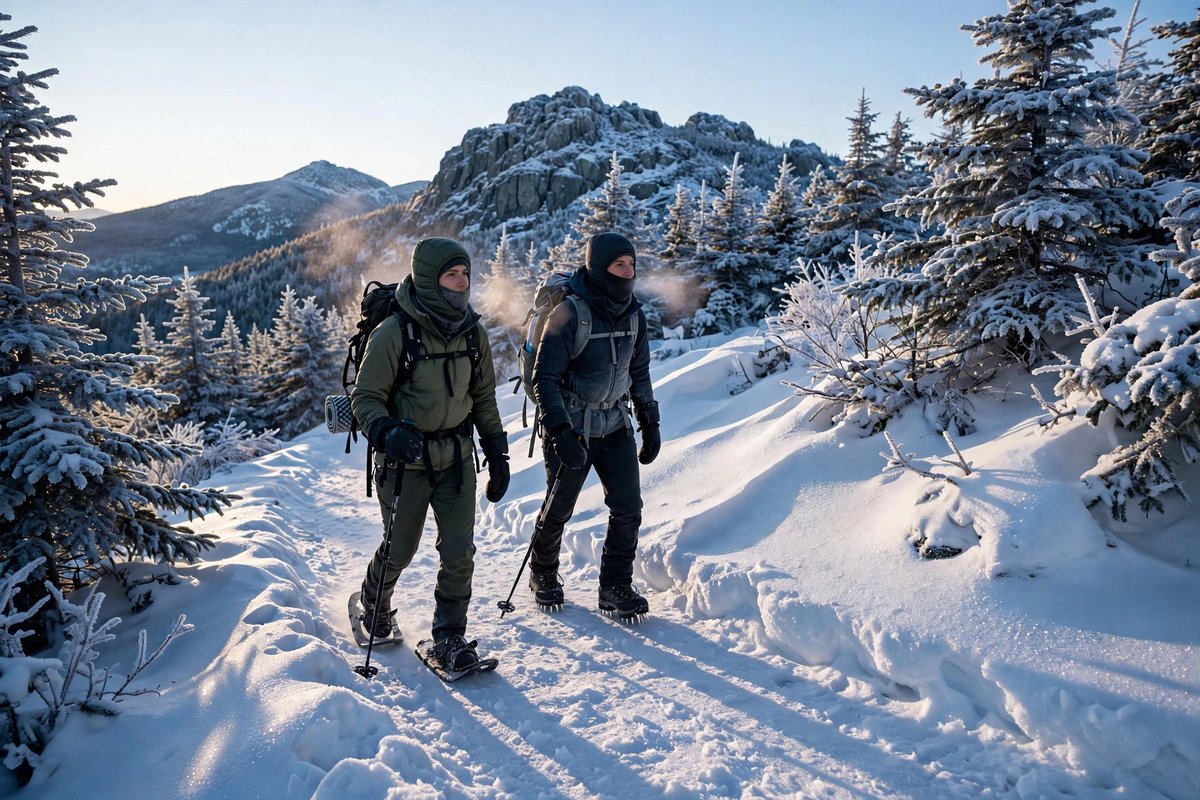
A Vermont winter hike rarely gives you just one kind of trail. You can start on packed snow, climb through loose powder in the spruces, and finish on wind-polished ice near the summit — sometimes all before lunch. Add a January morning that starts below zero in the valley and feels colder still above treeline on Mansfield or Camel's Hump, and the answer is rarely "more gear." It's the right four pieces: traction for ice, flotation for deep snow, a base layer that handles sweat on the climb, and mitts that still work when you stop moving. Here are four picks we'd point a friend toward, with the honest limits of each.
1. Kahtoola MICROspikes — the pair that lives in the pack all winter
If you buy one thing here, make it these. Vermont's freeze-thaw cycle turns trails into ribbons of water ice where meltwater crosses and refreezes overnight. MICROspikes are the step up from coil-style grips that skate on real ice: 12 heat-treated stainless steel spikes per foot, 0.41 inches long, on welded stainless chains that flex over rock and packed snow.
The harness matters too: a thermoplastic elastomer Kahtoola says stays stretchy down to -22°F, with reinforced eyelets, a toe bail, and a heel tab you can grab with gloves on. A medium pair weighs 11.9 ounces and packs to about 5 x 3 x 2 inches in its tote — no excuse to leave them home.
Who it's for: Anyone hiking Vermont trails from first freeze to mud season — when the ice is worst.
Honest downside: These are not crampons — steep, technical ice still needs the real thing. Wet snow can ball under the chains, and bare rock wears the spikes, so pop them off when the ice ends.
See the Kahtoola MICROspikes on Amazon (select your size and color)
2. MSR Evo Trail Snowshoes, 22 inch — flotation without the fuss
Once the snow is deeper than your boots, traction stops being the problem — sinking is. The Evo Trail is MSR's no-drama answer: a one-piece injection-molded UniBody deck, 22 by 8 inches, with steel crampons and traction rails molded in for packed trails and modest slopes. A pair weighs 3 pounds 10 ounces and is rated for loads up to 180 pounds.
Two details suit Vermont well. The Paraglide bindings use stretch mesh that hugs the boot without pressure points, fit men's 3–13 and women's 5–15, and have glove-friendly straps — no bare fingers on buckles at 5 degrees. And the deck accepts MSR's optional 6-inch flotation tails (sold separately), raising the load rating to 250 pounds. Made in the USA from US and imported parts.
Who it's for: Hikers on rolling, wooded Vermont terrain — state parks, town forests, moderate mountain approaches — who want one durable pair that just works.
Honest downside: There's no heel lift, so steep climbs work your calves, and 22 inches is small for a heavier hiker in untracked powder. For steep above-treeline routes, look at a mountaineering snowshoe instead.
See the MSR Evo Trail Snowshoes on Amazon (22 inch, Midnight)
3. Smartwool Intraknit Thermal Merino Base Layer Crew — warm on the stop, not just the climb
Staying warm below zero is mostly a sweat problem. Climb hard in too much insulation and you soak your layers; stop on a windy ridge and that moisture turns on you. Smartwool's Intraknit Thermal crew is built for that stop-and-go rhythm. The men's version blends 53% merino wool, 44% polyester, and 3% elastane — merino for warmth and odor resistance, polyester for faster drying — at about 208 grams.
Instead of one uniform fabric, the knit does the work: insulation, articulation, and ventilation zones are knitted in seamlessly, with mesh where you dump heat and 3D mapping that moves with your arms and shoulders under a pack. The fit is slim, so it disappears under a fleece and a shell.
Who it's for: Winter hikers who run hot on the climb and cold at the summit — most of us. Men's and women's versions are available.
Honest downside: Slim means snug; size up if you like a loose fit. And it's only a base layer, with no wind resistance of its own — below zero it still needs a mid-layer and a shell over it.
See the Smartwool Intraknit Thermal Crew on Amazon (select men's or women's, size and color)
4. Kinco 901T Pigskin Mitts — the patroller's answer, at a working price
Ask ski patrollers, plow drivers, and loggers what keeps their hands warm all winter and a lot of them hold up the same golden pigskin mitt. The Kinco 901T is a work mitt first: a grain pigskin palm with a suede pigskin back, reinforcement patches on the palm, thumb, and fingers, all sewn with heavy Draylon thread. Pigskin's trick is that it stays soft and flexible after it gets wet, where cheaper leathers dry stiff as cardboard. A packet of Nikwax waterproofing wax comes in the box — rub it in and the leather shrugs off wet snow.
Inside, Kinco's Heatkeep thermal lining is laminated to a soft TR2 liner built like a five-finger glove inside the mitt, so each finger gets its own insulation: more warmth than a plain mitten, and more dexterity than you'd expect. The Omni-Cuff knit wrist can be worn inside or outside your sleeve cuff to seal out snow. There is no gauntlet, no removable expedition liner, no space-age shell — just leather, insulation, and decades of Vermont winters. For trail days, wood piles, and below-zero mornings, it's the mitt people who work outside actually buy, at a fraction of what the mountaineering brands charge.
Who it's for: Anyone who wants warm, tough mitts without the mountaineering markup — hikers, patrollers, wood-stackers, snowblower operators, and parents stationed at the sledding hill.
Honest downside: The knit wrist is shorter than a gauntlet, so wear the mitts under your shell cuffs in deep snow. They're water-resistant — better once you apply the Nikwax — but not waterproof, and on a stationary, above-treeline January day you'll still be glad for a thin liner glove underneath.
See the Kinco 901T Pigskin Mitts on Amazon (select your size)
The bottom line
Traction in the pack, flotation when the snow gets deep, a base layer that manages sweat, and mitts that still work when you stop — that's a kit for everything from an icy March morning on the Long Trail to a below-zero sunrise on Mansfield. Dress for the stop at the top, not just the climb, and winter becomes the quietest, best season on these trails.
As an Amazon Associate we earn from qualifying purchases.