
In the middle of Plymouth Notch, a village so well preserved it feels like a page from 1923, stands a tall white clapboard building with a simple promise at its heart: cheese, made the old way. This is the Plymouth Cheese Factory, built in 1890 and still making cheddar in the same rooms today, in the middle of the President Calvin Coolidge State Historic Site. The company calls its cheese America's oldest cheddar, made from the original 1890 Vermont recipe, and the little factory is often described as the second-oldest cheese factory in the country. Best of all, it is no museum piece, but a working, family-run creamery.
What Plymouth makes is granular curd cheddar, a style with roots in the farmhouse cheeses America's first settlers produced in the 1600s. The curd is cut small, stirred as the whey drains, salted, pressed, and aged, which gives the finished cheese its firm, slightly crumbly bite and its deep, savory flavor. Every cheese starts as raw milk from a single nearby herd, the Jersey and Holstein cows at Woodlawn Farmstead, and the whole process happens on site, from the make room to the aging shelves to the final hand-dipping of each block in colorful wax, a different color for each flavor, as it was done a century ago.
The lineup fans out from one flagship. East Meadow is the youngster, aged about 60 days, while Original Plymouth rests a full year and Hunter matures for more than two years. Around them sits a pantry of flavored cheddars in bright wax: Black Truffle, Garlic Peppercorn, Sage and Herbs, Hot Pepper, Smoked, Sambal, Harissa, and Farmer Fred's Favorite, plus two cave-aged wheels, the washed-rind Grace's Choice, named for First Lady Grace Coolidge, and a Tomme in the style of Savoie, and a Brie made to the family's own recipe. The cheeses have collected ribbons over the years, including American Cheese Society awards for the Original, Sage and Herbs, and Hot Pepper, and a gold medal at the Big E for Grace's Choice.
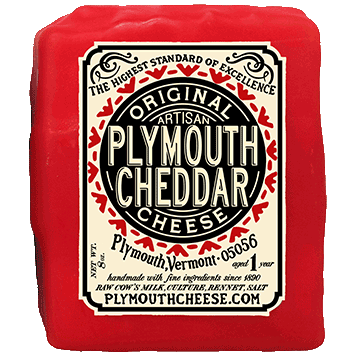
The nicest way to meet this cheese is in person. The factory store at 106 Messer Hill Road is open every day from 11 a.m. to 5 p.m., and a visit is a self-guided wander: viewing windows look into the cheese rooms where the cheesemaking happens, the little retail store stocks the full line alongside other Vermont foods, and upstairs a display of antique equipment tells the longer story of Vermont cheese. The store keeps its daily hours right through winter, even when the rest of the historic site is in its quiet season, which makes Plymouth Notch an easy cold-weather stop between Ludlow and Woodstock. Stretch your legs on the village paths afterward; the hills all around are fine walking country, and the Green Mountain Club's Day Hiker's Guide to Vermont is a good companion for the trails in nearby Coolidge State Park.
The story starts with a practical problem. In 1890, Colonel John Coolidge, a Plymouth dairy farmer, built the cheese factory as a way to extend the shelf life of his milk, turning a perishable surplus into a food that kept. His recipe was the granular curd method Vermont farmers had carried from the old country, and the factory became part of village life. The Coolidge name is woven through Plymouth Notch, of course: the colonel's son Calvin was born and raised in the village, in a house you can still visit a short walk from the factory door.

Fate gave the little factory a famous chapter. In August 1923, Calvin Coolidge, by then vice president, was sworn in as the 30th president of the United States in the middle of the night at his childhood home, after word arrived that President Harding had died. Plymouth Notch became a place Americans wanted to see, and First Lady Grace Coolidge took an early hand in preserving the cheese factory, which drew visitors even through the Great Depression. But hard times caught up with it anyway: the factory closed in 1934, when a milk shortage in the Depression years left it without enough milk to make cheese. For more than two decades, the vats sat silent.
The first revival came from the family itself. In 1960, John Coolidge, the president's son, returned to Plymouth Notch and brought his grandfather's factory back to life, reintroducing Plymouth Cheese to a new generation of travelers finding their way to the Notch. He ran it for nearly four decades, and in 1998, at the age of 92, he sold the factory to the State of Vermont, with the understanding that cheese would continue to be made there as long as the building was standing. The Coolidge family still owns about 500 acres of the small hill farms surrounding the village, so the landscape this cheese comes from remains much as it was.

The second revival belongs to Jesse Werner. A Vermont native who grew up on a small Franklin County farm, Jesse first made cheese as a teenager, helping a neighbor who made feta after school, and the craft never let go of him. He attended the Vermont Institute of Artisanal Cheese at the University of Vermont and apprenticed with the renowned Quebec cheesemaker Marc Andre St. Yves. When he learned the state was looking for someone to run the Plymouth factory, he submitted a proposal to revive the building and the original 1890s recipe, and by the summer of 2009 he was making cheese in Plymouth Notch. Reviving the recipe was part archaeology: Jesse worked from the original recipe preserved in the state archives and consulted a woman in town who had been head cheesemaker there in the 1960s. His wife, Sarit, designs the labels and branding, modeled on the factory's original look.
Keeping an antique factory thriving in the twenty-first century takes some gentle updating. In the early days of the revival, Jesse made 40-pound wheels the old way, until it became clear that modern shoppers would rather carry home an eight-ounce bar, so that is the size Plymouth makes today, hand-waxed and brightly labeled. New flavors keep joining the family, from harissa to a Brie made to the Werners' own recipe, and the online shop ships waxed blocks across the country, a natural Vermont gift when the holidays roll around. The through-line is experimentation without amnesia: new varieties, yes, and always the 1890 recipe underneath.
So what is next for a cheese factory that cannot grow? The building is a state historic site, so no addition will ever be tacked onto the 1890 walls, and the Werners found room to expand one town over. In 2021 the family bought a 75 percent share of the old Bridgewater Mill, a 100,000-square-foot former woolen mill, first as warehouse space for Plymouth Cheese shipping and storage. The mill has since been filling up with artists, makers, and small businesses, and the family hopes a coffee shop or bakery joins them, which would make Bridgewater a second stop on a Plymouth Cheese day. Back in the Notch, the plan stays deliciously simple: keep making the original cheese, in the original building, for the next generation of visitors. See the full listing on Green Mountain Guide: Plymouth Cheese.