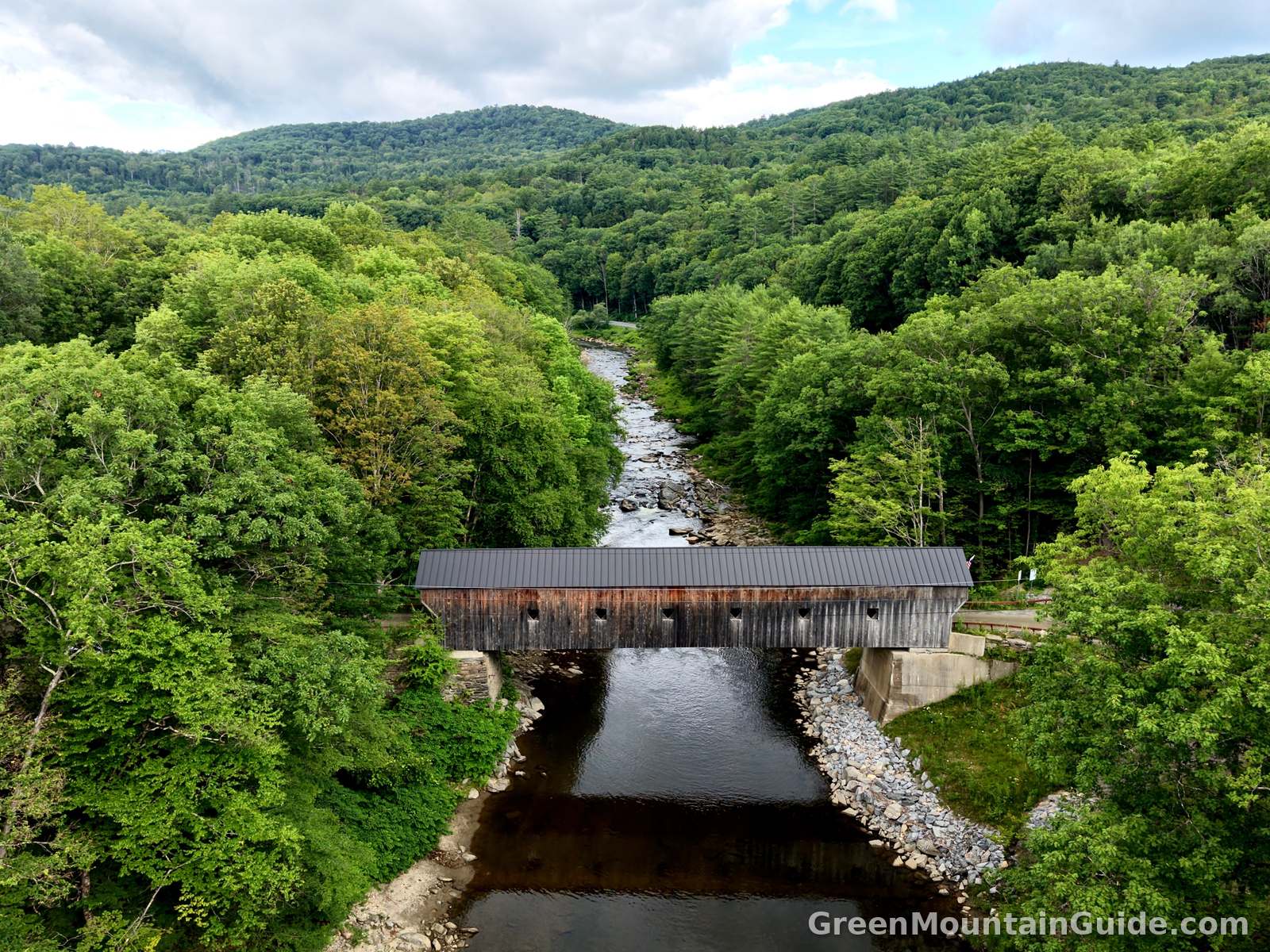
Yes. Most of them, anyway. Vermont has more than 100 covered bridges still standing, and the great majority are not museum pieces or decorations. They are working road bridges on public roads, carrying school buses, mail trucks and farm pickups every day. If your car fits and the signs allow it, you are not just permitted to drive through, you are expected to. That is what they are for.
A few are not for driving, and the whole trick of a good bridge outing is knowing which is which before you are nose to nose with one. Here is how to do it well.

*Taftsville Covered Bridge in Woodstock, built 1836: 189 feet long, the oldest covered bridge in Windsor County and the second-longest in Vermont. Photo: Magicpiano via Wikimedia Commons (CC BY-SA 3.0)*
## Step 1: Pick your bridges before you go
Of the 107 bridges in our bridge pages, 12 stand on private roads or footpaths, where driving is not an option at all. A handful of others are walk-through only. The Creamery Bridge in Brattleboro (1879) is the classic example: a real covered bridge in a lovely spot, and pedestrians only. Everything else is a public road bridge you can drive, free, in any season.
So plan a loop instead of chasing single bridges. Around the Okemo Valley, five good ones make a natural half day: Upper Falls in Weathersfield (1840, 120 feet over the Black River), Taftsville in Woodstock (1836, 189 feet), little Bowers in West Windsor (1919, just 45 feet), the Windsor-Cornish Bridge in Windsor (1866), and the Worrall Bridge in Rockingham (1870), which still has the rare wooden ramp at its northwest entrance. String them together and the driving between bridges, on valley roads along the Black River and the Connecticut, is half the pleasure.
End any route at the Windsor-Cornish if you can. At 449 feet it is the longest wooden covered bridge in the United States, and driving its full length, through the long shadowed interior with the river appearing in slices between the siding boards, is the single best covered bridge experience in Vermont.
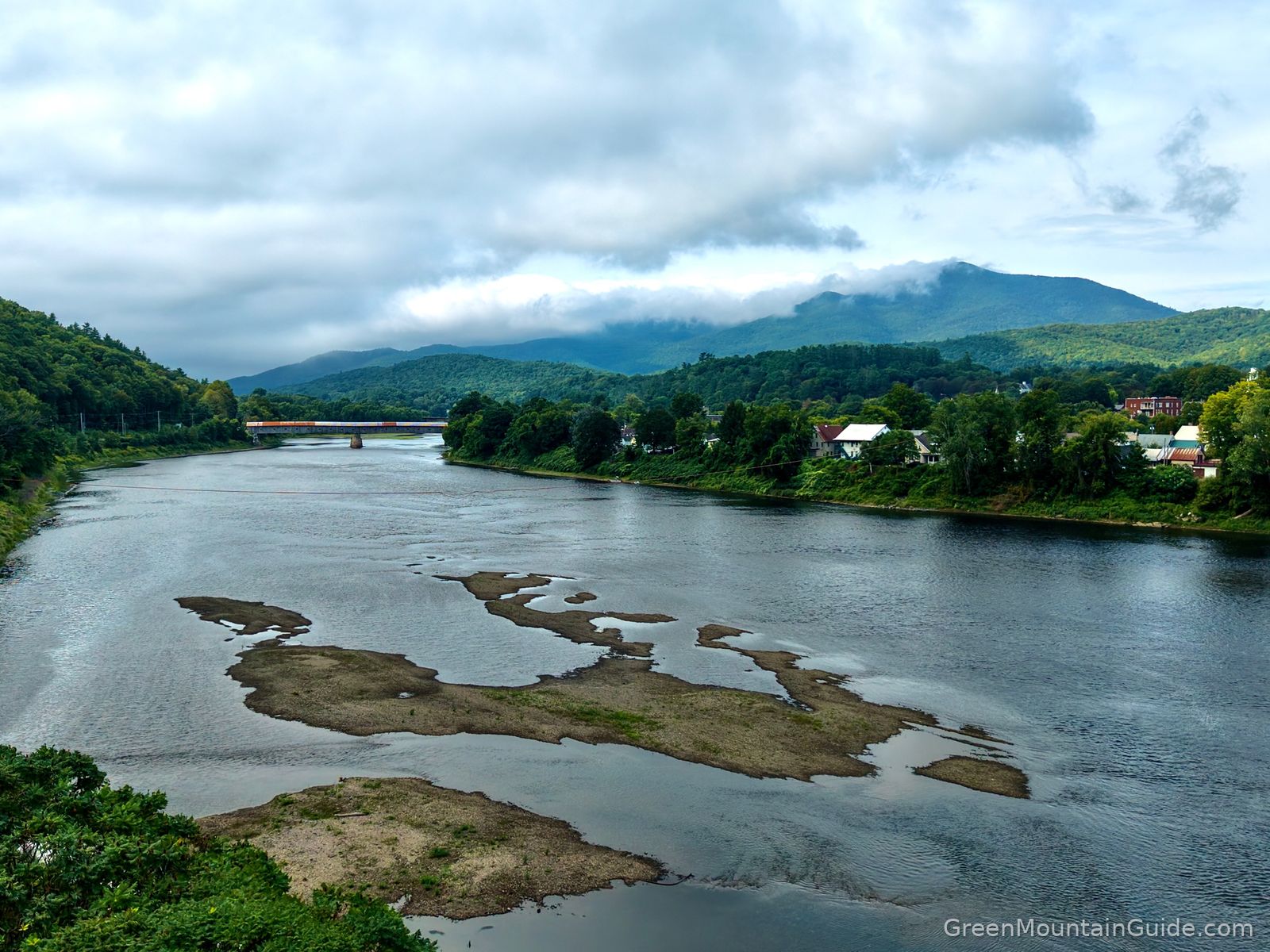
*Windsor-Cornish, 449 feet over the Connecticut River. Drive it slowly; it takes longer than you think. © Shirley Clark*
## Step 2: Read the signs at the portal
Every drive-through bridge posts its rules on the end you are facing, and they are worth the ten seconds it takes to read them. Three things to look for:
- **Weight limit.** Posted limits on Vermont's covered bridges typically run 6 to 8 tons. Any ordinary car, pickup or SUV is far under that, but a loaded truck or a big RV may not be. - **Clearance.** The height is posted because the portal is the tightest point. If your vehicle is anywhere near the number, do not gamble. - **One lane.** Nearly all of these bridges are a single lane wide. That one sign shapes everything about the crossing, covered next.
These signs are not decoration, and Bowers Bridge is the local proof. Tropical Storm Irene lifted the little bridge off its abutments in 2011 and carried it some 500 feet downstream, and after it was fished out and rebuilt, it has been struck several times by oversized vehicles that did not fit. The town has talked about closing it to traffic altogether. Read the portal, every time.

*Bowers Bridge in West Windsor: 45 feet long, rebuilt after Irene, and struck more than once since by vehicles too big for it. Photo: Djmaschek via Wikimedia Commons (CC BY-SA 4.0)*
**Driving something tall or heavy?** Know your real numbers before the trip, height including the air conditioner or anything on the roof, and weight loaded, not empty. If a bridge's posted limits are close to your numbers, route around it on a main road. And if you misjudge, back out while you still can. The one place never to discover you do not fit is halfway inside.
## Step 3: The crossing itself
The etiquette is simple and a century old:
1. **Stop before the entrance** and look all the way through. The far end is your visibility check. If you can see daylight and an empty lane end to end, you are clear to go. 2. **Yield to whoever is already in the bridge**, and to anyone waiting at the far end who got there first. One vehicle at a time is the rule on a single-lane bridge, in both directions. 3. **Cross at a walking pace.** The deck is wood, often uneven, and the inside is darker than your eyes expect after bright daylight. Slow is not just polite, it is how you see the far portal, the occasional pedestrian, and the cyclist you did not know was in there. 4. **Stay centered and do not stop.** Keep rolling gently until you are fully out the far side.
In winter, add one caution: the shaded wooden deck can hold ice after the road on both ends has cleared. Take the crossing gently and leave extra room.
## Step 4: Photos, without blocking the bridge
The one firm rule: **never stop inside the bridge for a photograph.** It is a single traffic lane with no shoulder and poor sight lines, and the car behind you cannot see you until it is in there with you.
The working method is easy. Drive all the way through, pull off past the far end wherever there is a safe shoulder or turnout (many bridges have a small pull-off, because everyone wants the same photo), then walk back and shoot from the bank or the roadside. The classic shot is the portal framed from a slight angle, and late morning light tends to treat the red paint best. If you step into the road for a straight-on view, listen first. These are quiet roads, but they are roads.

*Worrall Bridge in Rockingham, about 1870, photographed the right way: from outside, after crossing. Photo: Sfoskett via Wikimedia Commons (CC BY-SA 3.0)*
## Step 5: Back-road notes
Covered bridges live where Vermont keeps its back roads, so plan for back-road conditions:
- **Download your route before you leave.** Cell signal drops out in exactly the valleys where the bridges are. Offline maps turn a wrong turn into a shrug instead of a problem. - **Expect dirt.** Many bridge roads are gravel, and some are seasonal. In mud season the approach roads can be softer than the bridge. - **There is no fee and no season.** The bridges are public roads, open around the clock and all year. The buildings near them keep their own hours, but the crossing itself is always there. - **Give yourself more time than the map says.** Not because the driving is slow, though it is, but because you will keep stopping. That is the point of going.
So yes, you can drive through Vermont's covered bridges. Pick the public ones, read the portal, cross slowly one at a time, and take your photos from the far bank. Do that, and you are using these bridges exactly as the towns that built them intended: as roads that happen to be beautiful.

*The exception that proves the rule: Brattleboro's Creamery Bridge (1879) is for walking through, not driving. Photo: Beyond My Ken via Wikimedia Commons (CC BY-SA 4.0)*